

Procreation In Dying Nations
A data-driven exploration of the pockets of natural population growth in the developed world

A Quiet Lesson About Survival, Meaning, and Time
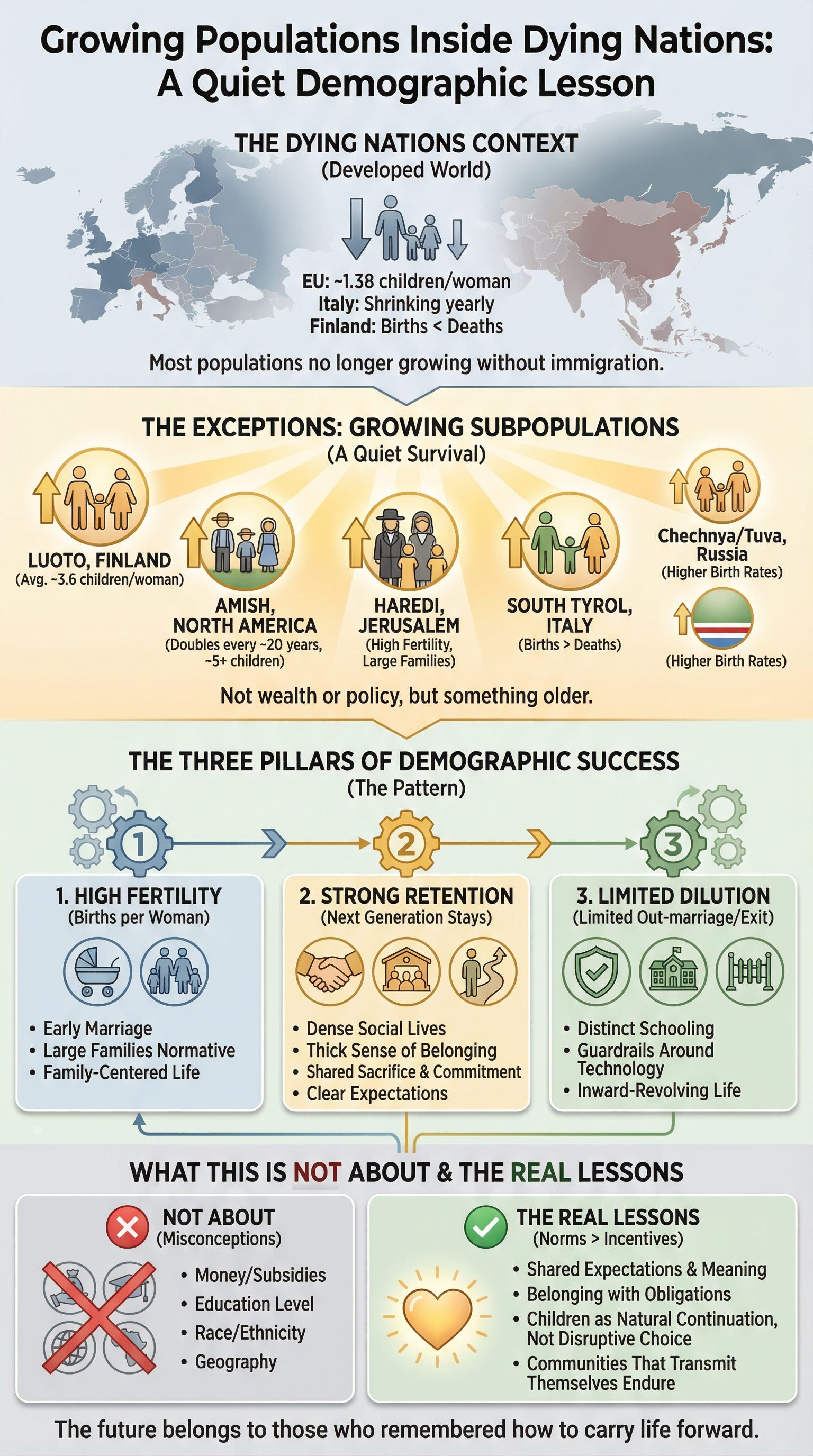
Picture the demographic landscape of the developed world as it now stands.
The European Union has reached a record low fertility rate of roughly 1.38 children per woman. Italy’s population is shrinking year by year. Finland’s birth rate has fallen to levels that would have seemed unimaginable a generation ago. Deaths now routinely outnumber births.
And yet, on Finland’s western coast, in a small municipality called Luoto, women have been averaging roughly 3.6 children each in recent years. Nearly three times the national rate.
Luoto is not alone. What it shares with an Amish settlement in Pennsylvania, a Haredi neighborhood in Jerusalem, or the mountain valleys of South Tyrol is not wealth, ethnicity, or modern policy design. It is something older, quieter, and easier to overlook.
The explanation forces a reconsideration of how human communities actually persist, and why many contemporary debates about fertility are aimed at the wrong targets.
The Great Demographic Reversal
In wealthy nations today, a simple arithmetic holds. If immigration is removed from the equation, most populations are no longer growing. Births fail to replace deaths across much of Europe, East Asia, and parts of North America.
This is not evenly distributed, nor is it random.
The exceptions follow a pattern so consistent that it borders on structural law. Natural population growth in the developed world is concentrated in specific subpopulations that share three features: high fertility, strong retention of the next generation, and limited dilution through out-marriage or exit.
These are not communities that merely identify as religious or traditional on a census form. They are communities that require concrete behaviors. Early marriage. Large families. Dense social lives. Distinct schooling. Guardrails around technology. A way of life that revolves inward rather than outward.
In demographic terms, their success can be reduced to a simple relationship.
Population growth depends on births per woman, multiplied by the share of children who remain, adjusted by whether new members are gained or lost. Most modern societies fall short on all three. These communities do not.
The Numbers That Resist Gravity
The scale of the contrast is difficult to ignore.
Among the Amish of North America, population estimates now exceed 400,000. Their numbers double roughly every two decades, not through conversion, which is rare, but through births and retention. Amish women commonly have five or more children. A large majority of Amish youth, often estimated at around four out of five, choose to remain in the community after a period of exposure to the outside world.
These young people are not unaware of modern life. They see it clearly, then decide that something else matters more.
Haredi Jewish communities present a similar pattern. In Israel, fertility among Haredi women remains far above replacement level, even after recent declines. Large families are normative. Community life is dense. Population growth is rapid enough to shape national politics, housing markets, and education systems.
In Finland, national fertility has fallen to historic lows, near 1.25 children per woman. Yet in certain coastal areas with strong religious subcultures, fertility remains dramatically higher. Luoto stands out, not because it is wealthy or newly settled, but because family formation remains central to social life.
In Italy, nearly every region is losing population through natural decrease. South Tyrol is a notable exception. Births have recently exceeded deaths there, making it one of the few places in the country where population continuity still holds without relying on immigration.
Beyond Western Europe, similar patterns appear in unexpected places. Within Russia’s generally low fertility environment, regions such as Chechnya and Tuva maintain significantly higher birth rates, supported by younger age structures, strong family norms, and cohesive cultural frameworks.
Different languages. Different religions. Different histories. The same underlying pattern.
What This Is Not About
Before drawing conclusions, it helps to clear away some common misunderstandings.
This is not primarily about money. Wealthy Nordic states offer generous family benefits and still record very low fertility. Meanwhile, communities that rely heavily on mutual aid rather than public assistance often raise large families.
It is not simply about education. While higher education correlates with lower fertility in the general population, there are communities where advanced study coexists with high birth rates because education is embedded within a family-centered life rather than positioned as its alternative.
It is not about race or ethnicity. The populations that continue to grow span continents and ancestries.
And it is not about geography. Some of the highest fertility subpopulations live in dense urban neighborhoods, not pastoral isolation.
The common denominator is not who these people are, but how their lives are structured.
How Norms Outperform Incentives
Most modern fertility policy operates on an economic assumption. Reduce the cost of children and people will choose to have more of them.
This assumption has repeatedly disappointed. Financial support can help families who already intend to have children. It does little to change underlying life plans.
High-fertility communities operate on a different logic. They do not make children cheaper. They make them expected.
When nearly everyone marries young, delay feels abnormal. When families of five or six are common, having one or two feels incomplete. When social life, identity, and status are tied to family formation, the trade-offs that dominate modern cost-benefit calculations lose their force.
Sociologists have long noted that demanding communities often endure precisely because they ask more of their members. Expectations reduce free riding. Shared sacrifice strengthens commitment. What looks restrictive from the outside often feels stabilizing from within.
Retention and the Weight of Belonging
High fertility alone does not sustain a population. Children must grow up and choose to remain.
Communities with high retention rates tend to offer something increasingly rare. A sense of belonging that is thick rather than symbolic. A network that shows up, not just online but in barns, kitchens, and hospital rooms.
Modern society often asks young people what they want to be. These communities ask what is needed of them. For many, the second question provides a clearer answer.
Freedom without roots can feel exhilarating at first, then exhausting. Belonging carries obligations, but it also carries meaning.
Technology and the Quiet Rewriting of Desire
Technology shapes behavior less by command than by repetition. It alters attention, comparison, and aspiration over time.
There is credible evidence that mass media and digital connectivity influence fertility-related behavior, especially among the young. These effects are usually modest in isolation, but significant in aggregate.
High-fertility communities tend to regulate technology for a simple reason. Norms cannot survive if every generation is immersed in environments designed to fragment attention and multiply alternatives. Culture, like memory, requires reinforcement.
This is not nostalgia. It is systems thinking.
What This Means for Aging Societies
Low fertility is often discussed as a fiscal challenge, a labor shortage, or a pension problem. It is all of those things. But at a deeper level, it is a signal.
Societies that struggle to reproduce themselves are not merely short on incentives. They are short on shared expectations about adulthood, family, and the future.
The populations that continue to grow, whether native-born or immigrant-origin, demonstrate the same truth. People have children most reliably when family formation is normal, supported, and embedded in a larger story about who they are and why they matter.
No subsidy can replace that story.
Closing Thoughts
History is patient but unsentimental. Wealth erodes. Technologies age. Only communities that transmit themselves endure.
The question facing aging nations is not how to persuade people to have children, but how to rebuild lives in which children feel like a natural continuation rather than a disruptive choice.
Until that question is answered, fertility will remain low, quietly and persistently.
And the future will belong to those who remembered how to carry life forward.